Get paid faster on every claim.
AI-first claim management for Indian hospitals. ECHS, ESI, PMJAY, CGHS and private insurers — pre-authorisation to settlement, managed end-to-end.
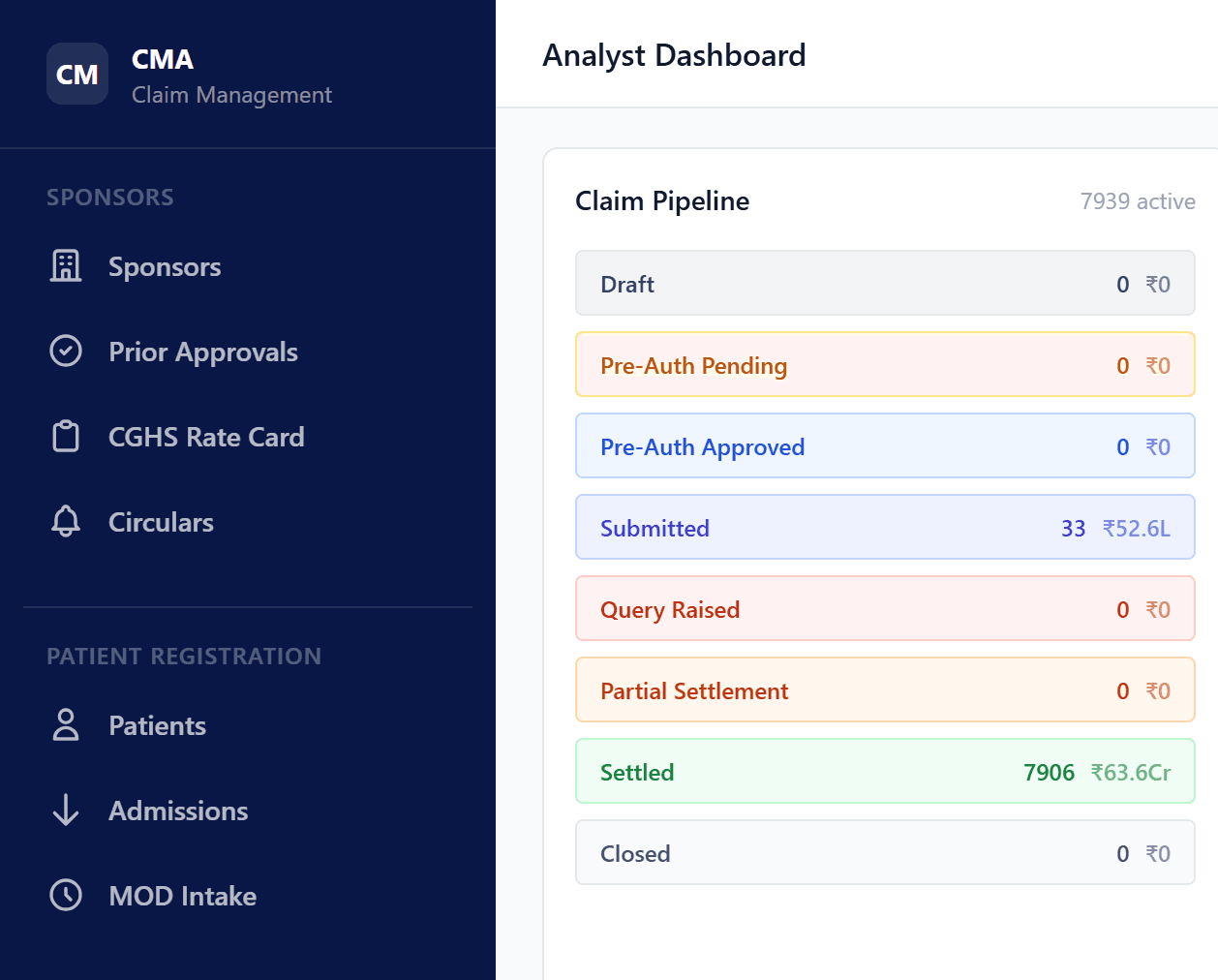
Pre-authorisation
Build, validate and submit pre-auth with IRDAI turnaround tracking.
Document intelligence
Extract and validate claim documents automatically, flagging gaps before submission.
Inpatient tracking
Track bills, treatment changes and non-payable items through the stay.
Claim submission
Submit to TPAs and insurers, and manage queries in one desk.
Settlement & recovery
Reconcile payments, contest disallowances and chase what is owed.
One system, the whole claim lifecycle
Every stage from the patient walking in to the money landing in your account — tracked, validated and audited in one place.
- STAGE 1Patient registration
- STAGE 2Pre-authorisation
- STAGE 3Admission & inpatient tracking
- STAGE 4Document assembly
- STAGE 5Claim submission
- STAGE 6Query management
- STAGE 7Settlement & reconciliation
What is inside
Thirteen modules, grouped into the five things a claims desk actually does.
Claims operations
Patient registration, pre-authorisation, inpatient bill tracking and submission — the day-to-day desk work, in one queue with turnaround timers on every step. Payments are reconciled against UTRs so nothing is written off by accident.
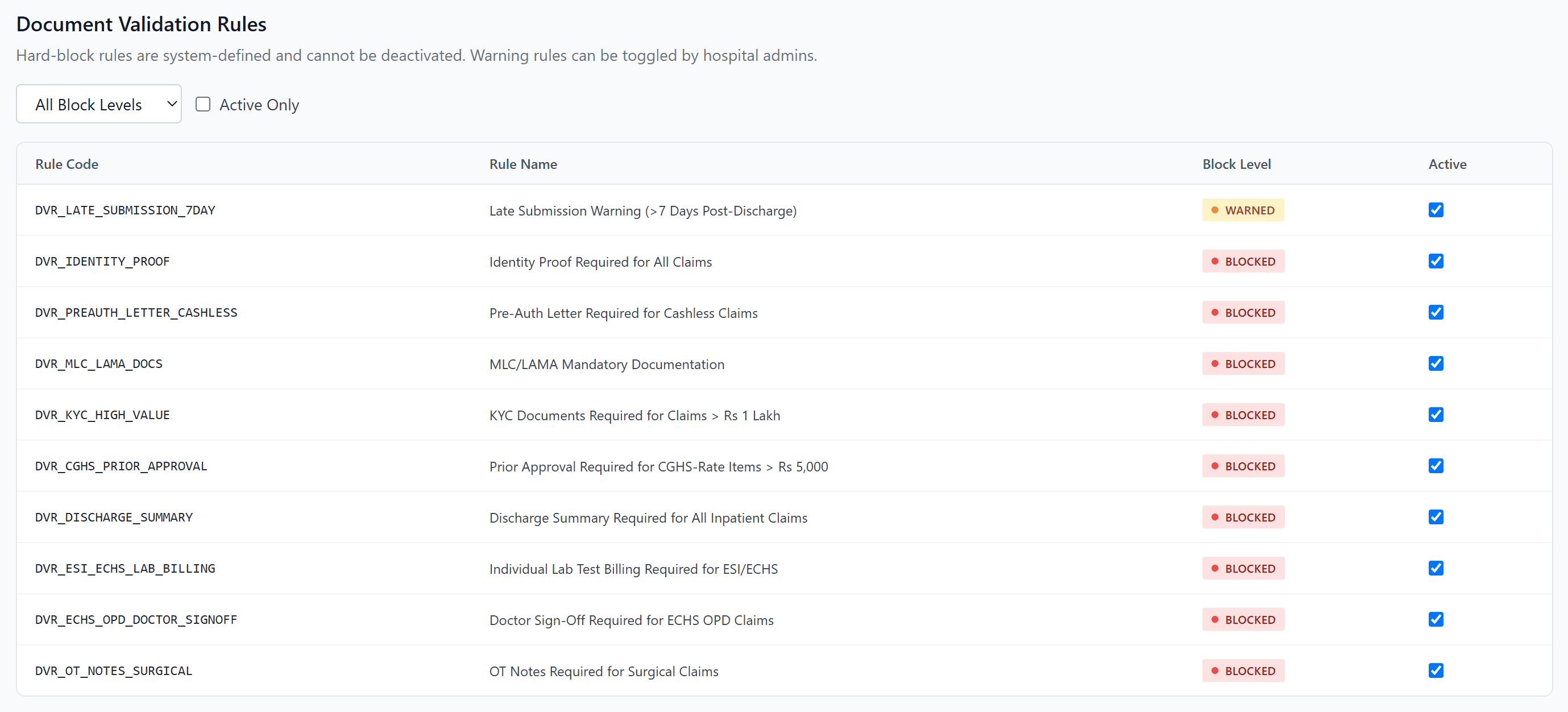
Document intelligence
Uploaded documents are read, classified and validated automatically. Missing or contradictory paperwork is flagged before a claim goes out, not after it comes back as a query.
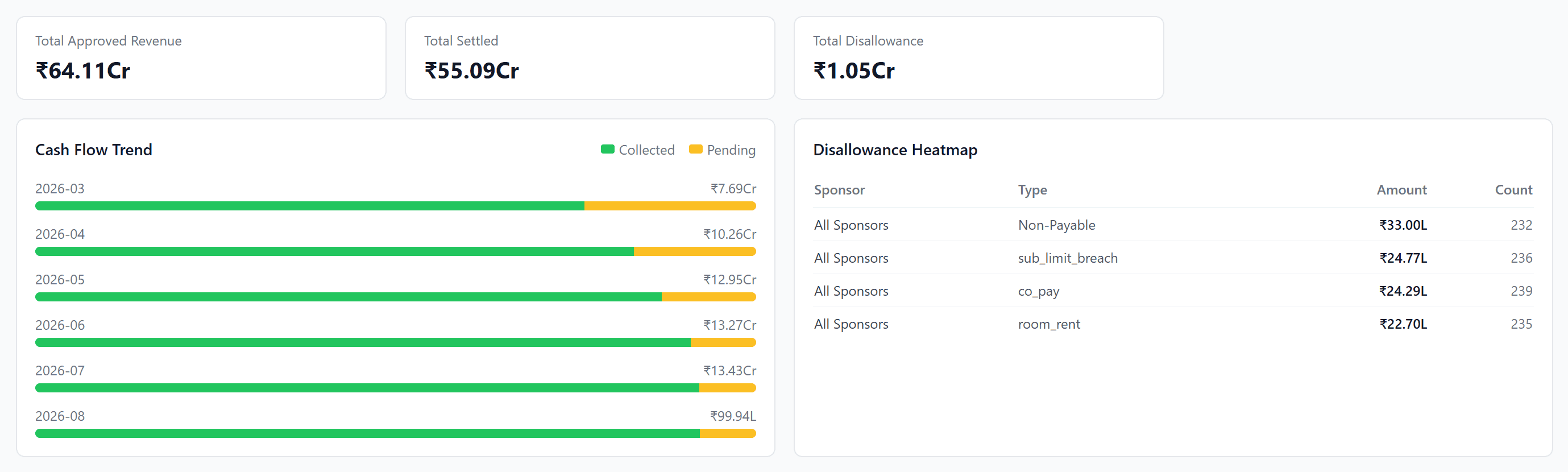
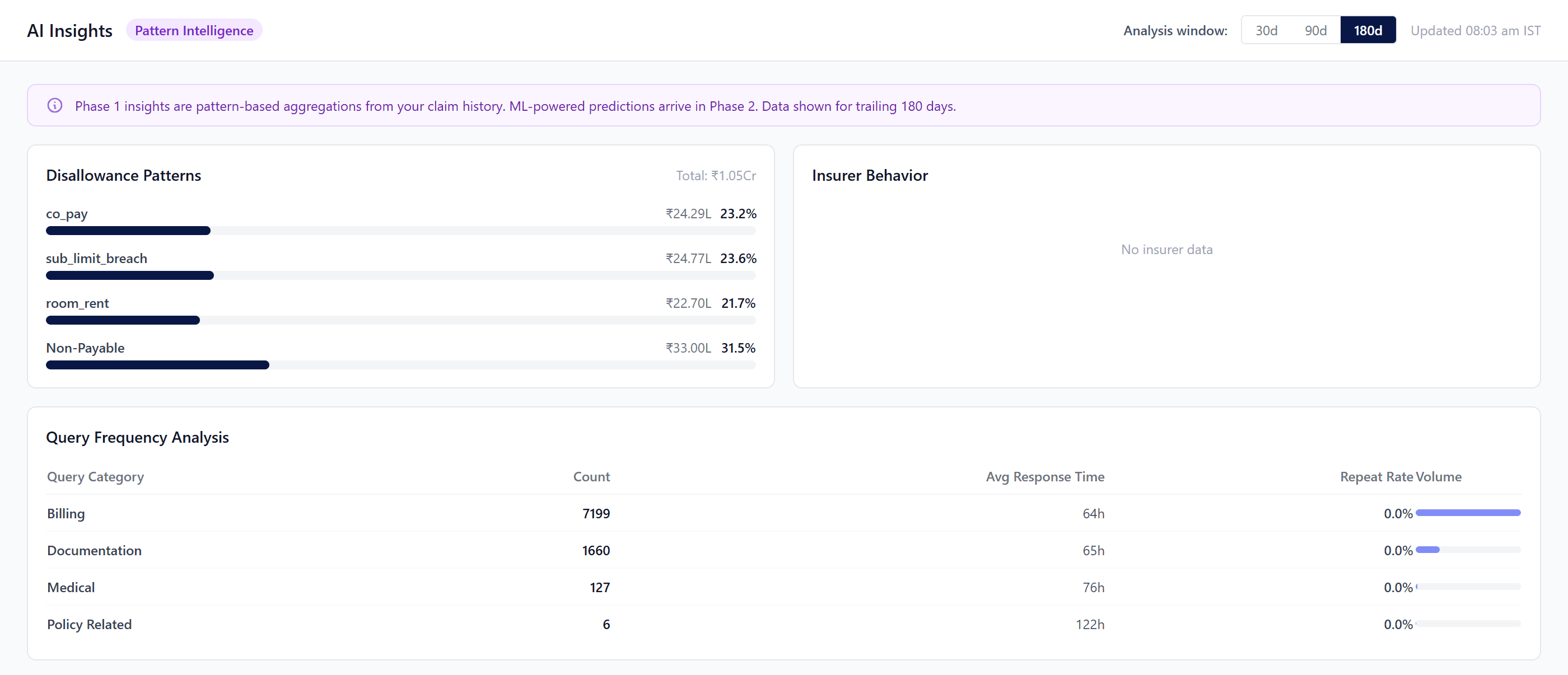
Analytics
Pattern intelligence over your own claim history: which disallowance types are costing you most, how often each query category recurs, and where turnaround is slipping.
Integrations
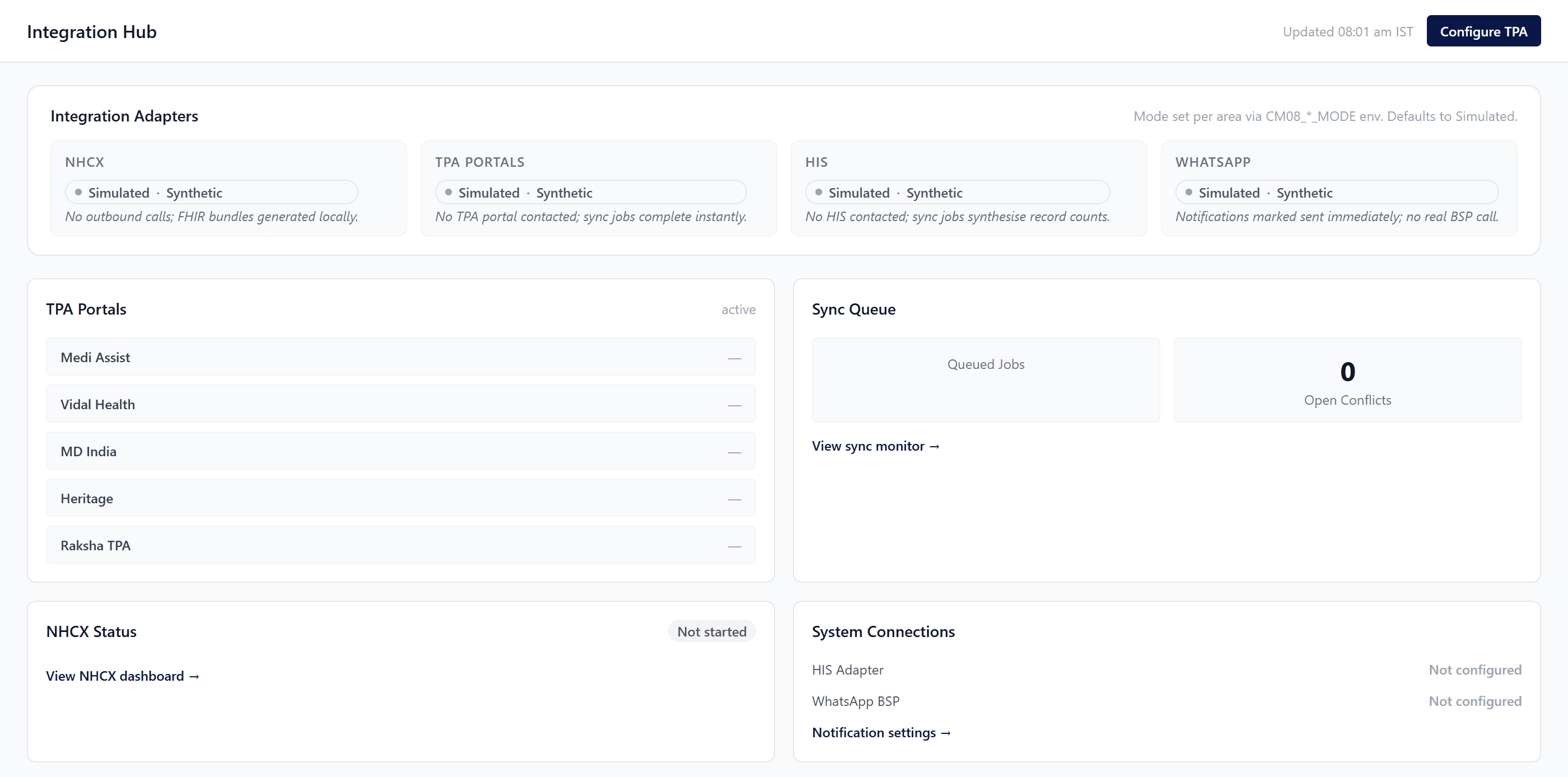
TPA portals, hospital information systems and NHCX. Sync jobs run in the background with conflicts surfaced for a human decision rather than silently overwritten.
Compliance
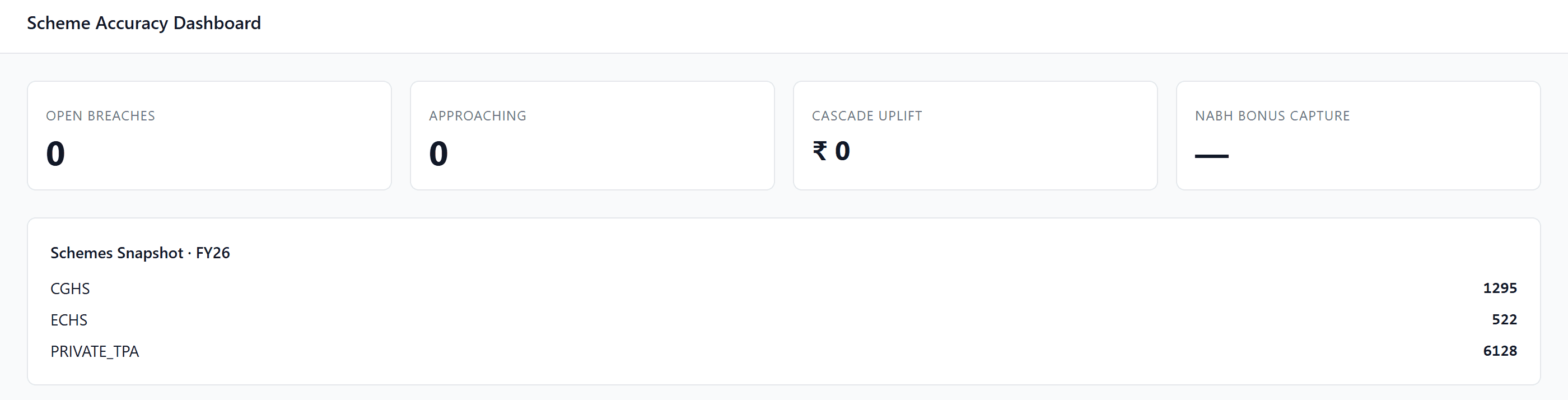
IRDAI turnaround rules, DPDP consent and breach handling, ABDM/NHCX certification and scheme-specific accuracy checks for CGHS, ECHS and ESI.
Compliance is not an afterthought
The regulatory rules are built into the workflow, so the compliant path is the default one.
IRDAI
Turnaround tracking against regulated timelines, with interest and penalty calculated on breach.
DPDP
Consent captured per purpose, breach register, data-principal requests and legal hold.
ABDM / NHCX
FHIR bundle submission on the certification path, with DHIS incentive tracking.
CGHS / ECHS / ESI
Scheme-specific rate cards, referral rules and accuracy checks applied before submission.
Common questions
How long does it take to get running?
Sponsor and rate-card configuration is the bulk of setup. Once your TPA and scheme details are loaded, a claims desk can start filing pre-auth the same week.
Where is our data stored?
Patient and claim data sits in a single tenant-isolated database, with row-level isolation enforced at the database itself rather than only in application code.
Which TPAs and schemes are supported?
ECHS, ESI, PMJAY and CGHS alongside private insurers and TPAs. Portals without an API are handled through assisted submission rather than being left manual.
How much integration work does our IT team need to do?
None to begin with — the system runs standalone. Hospital information system and NHCX integration are available when you want them, not prerequisites.
How is access controlled?
Role-based permissions per module and per action, so a desk analyst, a doctor and a finance user each see only what their role allows.